
San Jacinto County Bench Warrants Explained
“Bench warrant” is common shorthand for court process tied to a missed appearance or failure to follow an order. San Jacinto County courts may use a warrant, capias, capias pro fine, summons, or another instrument, depending on the case and stage. The court record controls. A missed JP traffic setting does not follow the same route as a district-court felony matter or a city ordinance case.
If you receive a notice or learn of a possible order, contact the court named on it. Ask what event led to the process and whether the court requires a personal appearance. A clerk can explain filing steps, but only the judge can rule on a request to recall or quash an order.
San Jacinto County Bench Warrant JP Routes
Class C and traffic cases go to the JP precinct where the citation was issued. San Jacinto County has four justice courts, with offices in Coldspring, Shepherd, Cleveland, and Point Blank. Each publishes its own phone and case materials. None of the four pages reviewed offered a public name-search warrant list, so use the ticket to find the precinct and call its clerk.
| Court | Local route | Published detail |
|---|---|---|
| JP1 | Coldspring | Traffic pleas and payment materials |
| JP2 | Shepherd | Payment methods and plea forms |
| JP3 | Cleveland area | Public page emphasizes civil forms |
| JP4 | Point Blank | Plea and indigency materials |
The Justice Court directory lists the current precinct contacts. A justice-court record is separate from a city municipal-court file.
San Jacinto County Bench Warrant FTA Notices
For certain justice or municipal cases, Chapter 45A requires notice and an opportunity to appear before an arrest warrant for failure to attend an initial setting. The notice identifies the court and date and explains options when a person cannot pay. The law also describes recall when a person voluntarily appears and makes a good-faith effort before execution. These rules do not mean every bench warrant follows one identical path.
San Jacinto County does not publish a local FTA flow chart. Ask the JP or municipal court what notice was sent, what deadline applies, and whether an appearance or recall is recorded. A later capias pro fine may follow judgment and unpaid costs, which differs from the first missed setting.
The current Texas Code of Criminal Procedure Chapter 45A outlines notice and recall procedure.
Read the current Texas Code of Criminal Procedure Chapter 45A with the issuing court's instructions.
How San Jacinto County Bench Warrants Are Issued
The issuing judge or court decides whether a missed setting or other event requires process. After an order is entered, the clerk records the case event and an authorized peace officer may be assigned to serve it. San Jacinto County does not publish one countywide system that shows every court's current service status.
For a justice or municipal case, statutory notice and ability-to-pay rules may apply. For County Court or district matters, use that court's procedure and docket. If a record says “issued,” ask whether a return, execution, recall, or later order has been filed before treating it as active.
San Jacinto County Bench Warrant Court Contacts
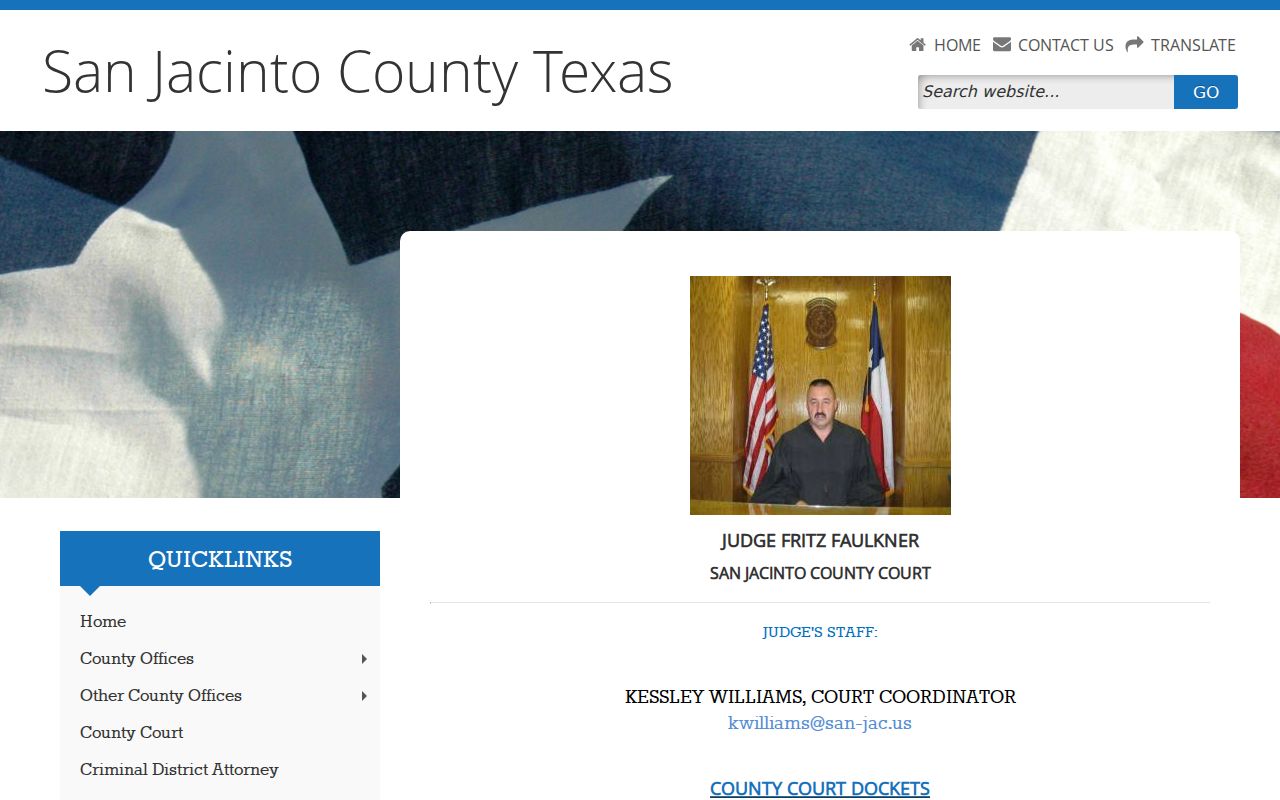
A misdemeanor bench matter in County Court routes through the County Clerk. Felony settings in the 258th or 411th District Court route through the District Clerk. The County Court page says staff cannot discuss a pending case ex parte, meaning privately with only one side. If a person cannot afford counsel, that page says to ask the judge about appointment. A clerk can give a public contact route, not legal advice.
For an FTA, tell the clerk the date that was missed and ask whether a separate order was entered and whether an appearance is required. Do not assume that paying a balance removes a warrant without a court record showing recall or satisfaction.
The County Court page explains criminal jurisdiction and the counsel route.
Courthouse security rules do not create a surrender appointment or guarantee a walk-in resolution.
Bench Warrants and Arrest Warrants Compared
Both kinds of process can direct an officer to take a person into custody, but the reason for issuance differs. In San Jacinto County, the file and issuing court determine which process applies. “Bench” often describes court-compliance matters; an arrest warrant under Chapter 15 is based on a complaint or other lawful basis tied to an offense. See the arrest-warrant process for that route.
| Feature | Bench Warrant | Arrest Warrant |
|---|---|---|
| Common trigger | Missed setting, payment, or court-compliance event | Complaint or other lawful probable-cause basis |
| Issuing route | Judge or court controlling the pending case | Magistrate under Chapter 15 |
| First contact | Clerk of the issuing JP, city, county, or district court | Issuing court; ask sheriff about service status |
| Resolution | Ask about appearance, payment, bond, or motion | Ask counsel and court about appearance or bond |
San Jacinto County Bench Warrant Capias Terms
A capias is post-judgment process directing an officer to arrest a person. A capias pro fine is used after judgment for unpaid fines and costs. Neither term should be treated as a generic label for every missed date. In a San Jacinto County file, ask whether the entry is an initial FTA warrant, a capias after judgment, or a later alias process.
The court can explain what event appears in the docket and what action remains. A JP or city court may have different payment, hearing, or hardship steps from County Court or district court. The exact instrument and status matter more than an informal phrase used on a notice or by a third-party website.
The statutory definitions are in the Texas Code of Criminal Procedure.
Resolving a San Jacinto County Bench Warrant
There is no official countywide surrender appointment or recall portal. Contact the court that issued the order and ask which options fit the record. A person may need to appear, file a motion, address an unpaid judgment, post a court-approved bond, or arrange counsel. San Jacinto County's published fee schedule lists several separate charges, but it does not set one total for every case.
- Ask the clerk what court issued the order and what process name appears in the file.
- Confirm whether the court requires an appearance, payment, hearing, bond, or attorney filing.
- Ask about personal bond, ability-to-pay review, or a motion to recall or quash.
- Get written proof of the court's action and ask whether any other agency needs an update.
Caution: Do not assume a payment receipt clears process. Confirm recall or satisfaction with the issuing San Jacinto County court and keep its written response.
San Jacinto County Bench Warrant Payment Options
When fines or costs are part of the matter, ask what ability-to-pay or indigency procedure applies. JP4 publishes an affidavit of indigency and material about inability to afford costs or an appeal bond. Chapter 45A also contains ability-to-pay protections for justice and municipal cases. Eligibility depends on the record, so request current instructions from the issuing court.
The posted fee schedule lists a $50 capias or warrant processing line, plus separate charges for bond approval, jail commitment or release, and time payment. Those are line items, not a universal clearance quote. Ask which items apply, how payment is accepted, and whether a separate appearance or court action is needed. No warrant amnesty or guaranteed walk-in release process was located.
Finding the Court That Issued the Warrant
A bench warrant stays with the court that set the underlying case. San Jacinto County's County Court handles Class A and B misdemeanor cases; the 258th and 411th District Courts handle felony matters. Each JP keeps its own precinct cases, and a city municipal court handles its own ordinance or traffic citations. The sheriff may serve process but does not replace the court's recall authority.
Use the case or ticket to route a question. If the court name is missing, the county's warrant lookup page explains which clerk and agency to contact for each type of matter. Federal court cases follow a separate system and cannot be cleared by a county clerk.